
Thursday, October 29, 2015

Connecting the Dots


"You can't connect the dots looking forward; you can only connect them looking backwards. So you have to trust that the dots will somehow connect in your future."
-Steve Jobs
Now why am I saying this? Like my last post, in what follows, I plan to elaborate on A.I. costs but also finally connect it with sustainability. 

Honestly, it might even get boring for some of you but there is a light at the end of the tunnel.


Moore's Law - Dot 1


See, you read 'Law' and now you're like, "It's boring already!" 

So, let's go with visuals. Below is a graph that pretty much summarizes what Moore's Law is. 

On the y-axis, it reads calculations per second per $1000. This means how much computing power you can achieve within the range value of $1000 (for a particular device; i.e. vacuum tube). The x-axis simply represents time in years. 

Essentially, you can think of Moore's Law as "the doubling of computing power every couple of years".

Image Source: Extreme Tech
What I want to get at is, that although the computing power is increasing, the cost is staying relatively the same ($1000).

Feeling skeptical? Keep reading.


Changes Over Time - Dot 2


With the introduction of transistors, computers became significantly smaller. Back then, computers used to be enormous. 
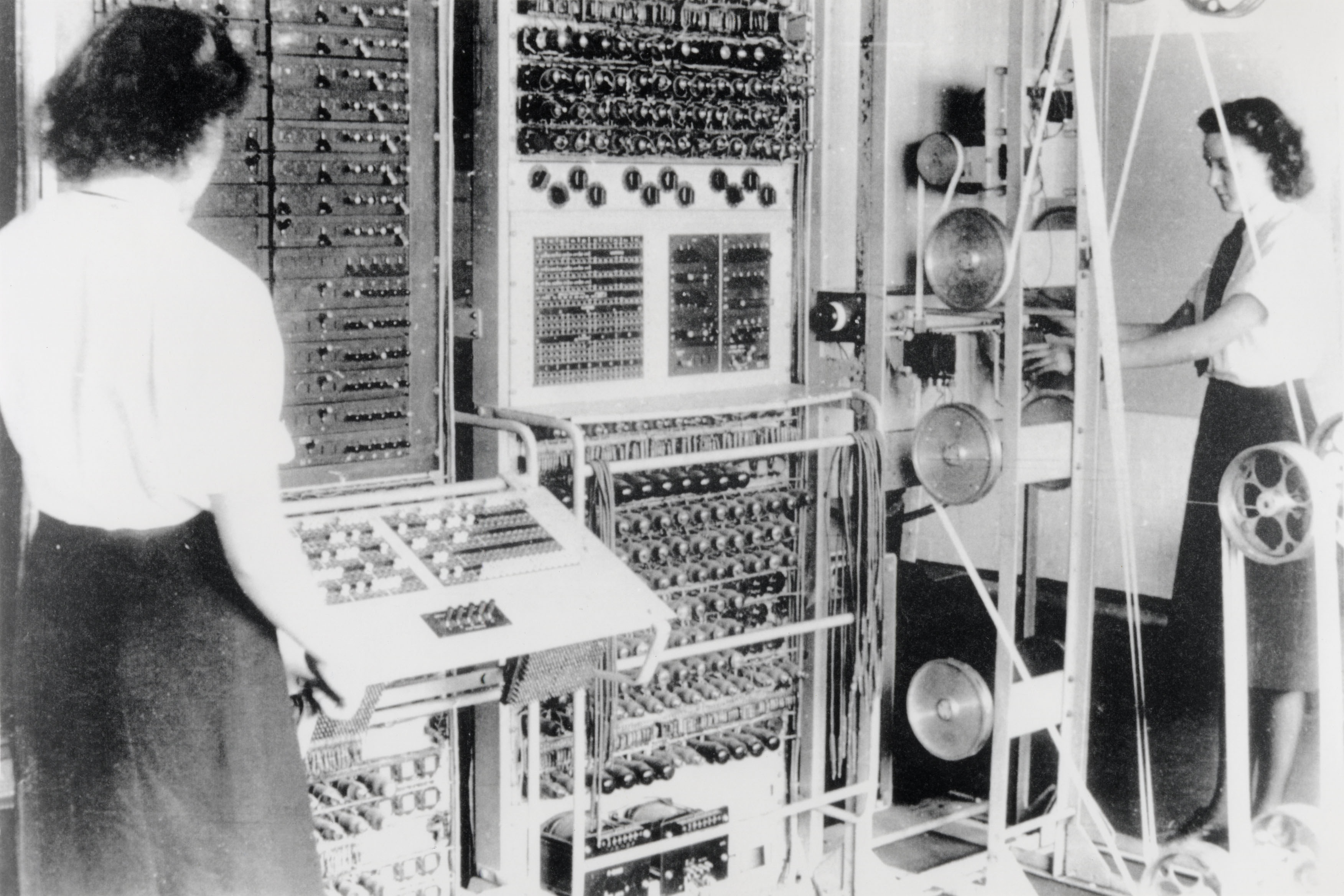
The Colossus Mark 2 computer; made before the switch to transistors.
Image Source: Wikipedia
Computers also used to be quite slow (as shown via calculations per second from the first graph). So how did we get computers that are faster and smaller? New technological developments and the compact making of these new technological developments make the current computers today possible. 

Again, Moore's Law. 


The Rise of GPUs - Dot 3


What a GPU looks like (AMD's Artic Island GPU)
Image Source: KitGuru
What are they?

Although there can be multiple definitions, a GPU is a graphic processing unit. It was originally used to generate images and graphics for games, but the discovery that they could be used for deep learning has changed the whole artificial intelligence ball game.

How?

To keep things simple, GPUs have an ability to handle certain kind of math calculations. This ability allows for a computer to mimic the way a brain works by having the GPUs work together in parallel.

They also happen to be cheaper. Remember the Google Cat experiment that Andrew Ng built a $1 million computerized brain for? With GPUs, it costs roughly $100 thousand and it contains more computing power (needed for the cat detector job).

So, over time, the expenses do go down given different implementations of making a system capable of deep machine learning.

Material Sustainability - Dot 4


Finally, sustainability. (It feels good to take a break.)

Currently, processors are made out of silicon. Silicon is the second most abundant element in the Earth's crust. Even so, should we worry if it will run out? 

Well, according to this graph below, we have other materials we should probably worry about firsst. (Silicon is not even on the graph.)

Image Source: Visual Capitalist

Okay, so making these computer systems are not exactly depleting our sources but what about when the lifetime of the systems are over? What goes into the waste production of these technologies and overall, what do these connected dots mean?

We will see in my next post.


Thursday, October 22, 2015

Deep Machine Learning; Some Numbers

Image Source: BIPB

"Sum" numbers?

Yes, although not exactly indeterminate, the amount of currently known A.I. research dealing with deep machine learning is actually pretty sparse - even more so with tools used for sustainability purposes.

As such, I was only able to retrieve a small set of numbers dealing with the cost of developing deep learning technology. Most of which are only indirectly related to the past sustainability tools I have mentioned.

With the information I have found however, there is one thing I can say for sure - I can do a lot with that kind of money.

Now, before I continue, I would like to say that it is going to seem like I am drifting from sustainability a bit. This post is going to be about a different kind of green but trust me, the dots will connect eventually.


So how much we talking?

Let me rewind a little bit.

Back in 2014, a startup firm based in London by the name of DeepMind Technologies, was bought out by Google.

Google. (Let that sink in.)

Now get this - they acquired this startup firm for about $400 million.


Okay, but for a startup?


Yes! Not surprisingly, this firm was not bought simply for its technologies. Although DeepMind Technologies was a firm that focused on deep learning, it was mainly bought for its group of expert A.I. researchers.

As I have hinted at before, deep learning is a relatively new field of computer science. Most articles of research that have been published about deep learning and artificial intelligence date from the last few months to last year (2014). 

Therefore, the experts in this field are limited. So rare, in fact, that, 

"..the cost of a top, world-class deep learning expert was about the same as a top NFL quarterback prospect. The cost of that talent is pretty remarkable. " 
This was said by Peter Lee, who heads Microsoft Research. They are in such demand that they command the same seven-figure salaries. 


And that was only for the researchers.

Image Source: Tumblr

What about the other stuff?


Computational hardware needed for deep learning are definitely not going to be cheap. Even today, buying a laptop with good specs costs $1000 easily. You are going to need more than that for A.I.

Clearly only businesses like the tech giants Facebook, Microsoft and Google can afford all of this. 

Andrew Ng, a chief scientist at Baidu Research in Silicon Valley, worked  a project at Google that dealt with deep learning. The objective was to build a computerized brain that could recognize cats in videos. 

Although he was successful, the system in which he used was a roughly 1-billion connection network trained on 1,000 computers. The system cost about $1 million. Another source says that Google used 16,000 machines to build this stimulated brain. If you are not getting the picture, this was only to detect cats on videos, specifically

Essentially, to do anything else, you're going to need a whole lot of money.


Now what about making this stuff?


Anytime you have to make anything - there is the issue of sustainability of the materials used. With computers and A.I., how does that work? I plan to address this, as well as a more positive outlook of A.I. in my next  post.

Stay tuned.

Tuesday, October 13, 2015

You Can Save Trees, A.I. Can Too

Trees are the lungs of Earth.
Photo credit: WWF
There are many different definitions for a forest and this definition ambiguity ranges anywhere from many trees to rain forests to tree plantations (as well as many more). In this case, I found that Global Forest Watch's definition fits best and puts it together quite simply,

"...'forest' refers to a landscape with a high density of trees and value for biodiversity, carbon storage, and human use."


So, why should anyone care?


The removal of forests, or deforestation, cause up to a fifth of greenhouse gas emissions. Clearly, preventing deforestation is one of many key factors to solving our current issues with global warming.

Also, biodiversity may not be preserved via deforestation. Habitats and homes of many different species (animals and greens) are eliminated and their survival is bleak. This affects everyone, not just the endangered species. (For example, it can affect the food chain.)

So if all we have to do is leave the trees, why are forests still being cut down?

Mainly, for profit. Nature aside, most of the deforestation that occurs is due to man. Especially for agricultural purposes - which accounts for 70 percent of deforestation in tropical countries. Had developed countries not commit the $8.7 billion towards Reducing Emission from Deforestation and Degradation of forests (REDD+), they could have raked in an agricultural subsidies' net worth of at least $486 billion in 2012.


How can A.I. help?


There is already a free online interactive tool available that helps with forest monitoring using satellite technology. This tool is called Global Forest Watch (GFW) and is produced by the World Resources Institute (WRI). Although anyone can use it, currently it can only produce near-real-time alerts. A forest could be well gone before any action against deforestation can take place.

A screenshot of the GFW interface as it is currently, available at GlobalForestWatch

Now, what if this tool could predict where deforestation can occur next?

A collaboration with Big Data technology startup, Orbital Insight, plans to use artificial intelligence to parse tens of millions of high-resolution satellite images to find and analyze predictive indicators of deforestation. (For example, new road construction in remote areas.) 

Of course it will be difficult for humans to identify these subtle changes - especially on a world scale. A.I., with it's computational ability, can find these factors more feasibly and can even store its mass findings.


Alright, so what's the catch?


Firstly, this cutting-edge technology is still underway - the article only being published this past April. The computational power needed to make this idea a reality is also going to be pretty expensive. Taking into account all other research expenses, this is not going to be a cheap process. 

Even if the collaboration between GFW and some kind of artificial intelligence were successful, what are the chances that real action will be taken? What kind of action can be taken? These are factors outside the scope of A.I. development.

The recurring question of whether or not the ends justify the means is something I hope to address more specifically in my next blog post. As we have seen, A.I. can definitely be used to improve different areas of sustainability, but again, is it worth it?

Thursday, October 8, 2015

What is A.I.? Does it mean "love?"

This is a brain, not a heart.

This is a brain, not a heart.

Image Source: IQ Evolve
Yes, the word, "ai," (pronounced eye) does mean "love" in Japanese. However, the kind of A.I. (commonly pronounced ay·eye ) I am referring to is an acronym that stands for artificial intelligence.

So are you talking... robots?


Kind of. The focus here are not the usual smarter-than-humans robots kind of artificial intelligence - the kind you usually see in the movies. What I am talking about are computational tools that can learn. How? By using deep learning, or deep machine learning. This is an artificial intelligence method that tries to mimic how the human brain works.

As said by Wenwen Li, a professor at Arizona State University developing a artificial intelligence tools, 


"Deep learning has a remarkable ability to derive patterns from complicated or imprecise data, have an ability to learn, are strongly self-organized, and can create their own representation of the knowledge received."


Uh, yeah, okay...so what?


To fully comprehend the greatness of deep machine learning, you will have to first accept and understand that computers are stupid.


Now before anyone gets offended, let me elaborate. I was told that over and over again in my computer science courses over the years. (Should you ever reach my blog, thank you Dr. McDowell.) What I mean is, (and to put things simply), computers do not understand the human language. They speak in 0's and 1's, and must be programmed by other people in order to understand (and do) what we want them to do.

So what if we gave them something that mimics the human brain - an ability for machines to think and act for themselves? That, is deep learning.

And that same technology can be applied to our current issues with sustainability.

Professor Li is currently in the process of developing an artificial intelligence tool that can help analyze geographical terrain overtime and use that information to calculate future changes in terrain. This means, predicting the Earth's future physical state! Quite the factor to human sustainability!

What's bad then?


Ah, yes, there are always two sides to a story. Since these tools can be used for sustainability purposes, it is quite contradictory then, that they also hurt sustainability. Like with most technology, these tools have to be produced. Made. See where I'm going here? 

Are the overall means justified by the end? 

So I forgot to mention, my name is Alee Khang. I am a Computer Science major, with a minor in Mathematics at Rhode Island College. Essentially, these new learning machine tools will be the subject of my blog. My main focus is analyzing these tools and gearing their "worth" towards sustainability. (After all, the world does matter.) 

AI hope you tune in.