"You can't connect the dots looking forward; you can only connect them looking backwards. So you have to trust that the dots will somehow connect in your future."
-Steve Jobs
Now why am I saying this? Like my last post, in what follows, I plan to elaborate on A.I. costs but also finally connect it with sustainability.
Honestly, it might even get boring for some of you but there is a light at the end of the tunnel.
Moore's Law - Dot 1
See, you read 'Law' and now you're like, "It's boring already!"
So, let's go with visuals. Below is a graph that pretty much summarizes what Moore's Law is.
On the y-axis, it reads calculations per second per $1000. This means how much computing power you can achieve within the range value of $1000 (for a particular device; i.e. vacuum tube). The x-axis simply represents time in years.
Essentially, you can think of Moore's Law as "the doubling of computing power every couple of years".
 |
| Image Source: Extreme Tech |
Feeling skeptical? Keep reading.
Changes Over Time - Dot 2
With the introduction of transistors, computers became significantly smaller. Back then, computers used to be enormous.
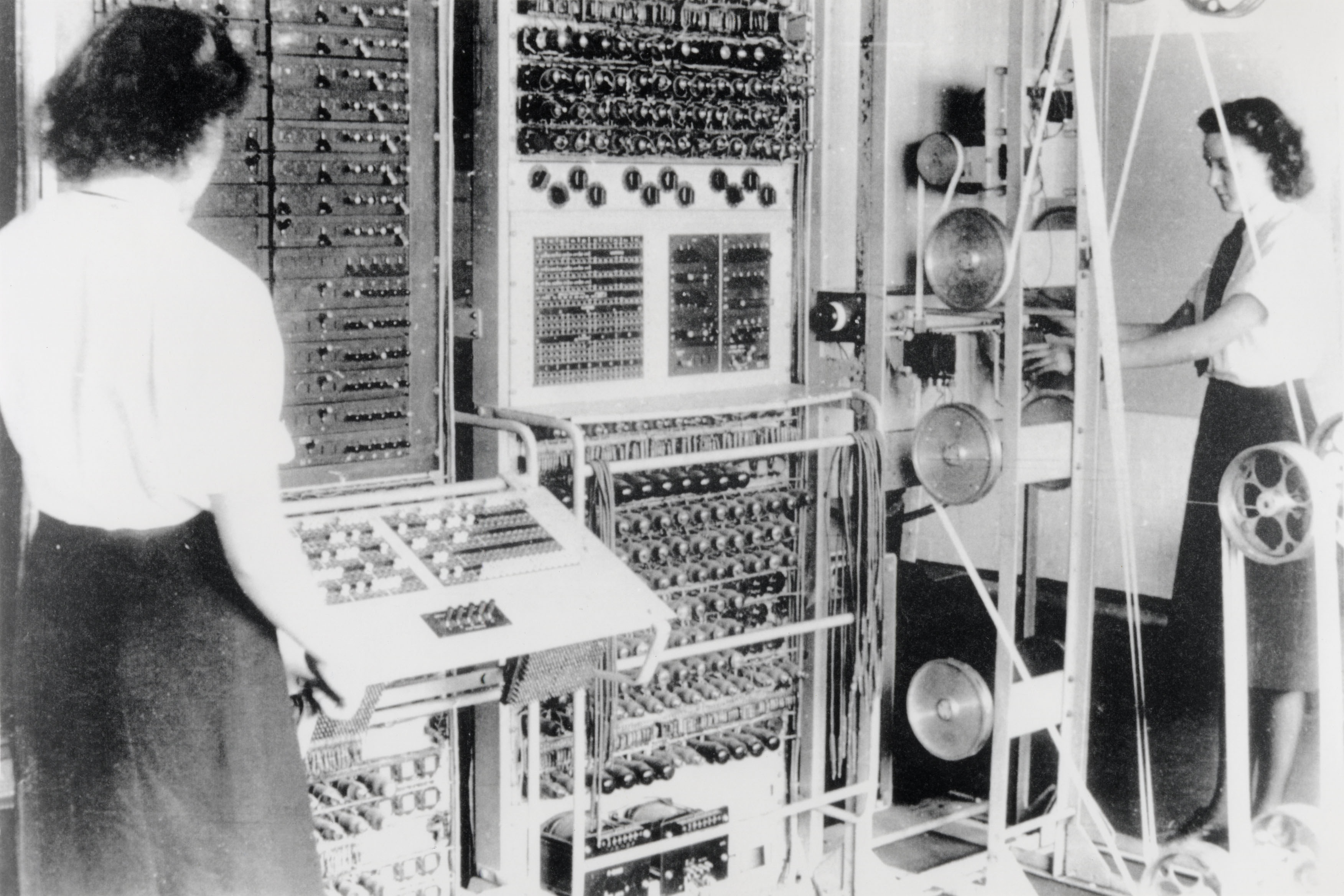 |
| The Colossus Mark 2 computer; made before the switch to transistors. Image Source: Wikipedia |
Computers also used to be quite slow (as shown via calculations per second from the first graph). So how did we get computers that are faster and smaller? New technological developments and the compact making of these new technological developments make the current computers today possible.
Again, Moore's Law.
The Rise of GPUs - Dot 3
 |
| What a GPU looks like (AMD's Artic Island GPU) Image Source: KitGuru |
Although there can be multiple definitions, a GPU is a graphic processing unit. It was originally used to generate images and graphics for games, but the discovery that they could be used for deep learning has changed the whole artificial intelligence ball game.
How?
To keep things simple, GPUs have an ability to handle certain kind of math calculations. This ability allows for a computer to mimic the way a brain works by having the GPUs work together in parallel.
They also happen to be cheaper. Remember the Google Cat experiment that Andrew Ng built a $1 million computerized brain for? With GPUs, it costs roughly $100 thousand and it contains more computing power (needed for the cat detector job).
So, over time, the expenses do go down given different implementations of making a system capable of deep machine learning.
Material Sustainability - Dot 4
Finally, sustainability. (It feels good to take a break.)
Currently, processors are made out of silicon. Silicon is the second most abundant element in the Earth's crust. Even so, should we worry if it will run out?
Well, according to this graph below, we have other materials we should probably worry about firsst. (Silicon is not even on the graph.)
 |
| Image Source: Visual Capitalist |
Okay, so making these computer systems are not exactly depleting our sources but what about when the lifetime of the systems are over? What goes into the waste production of these technologies and overall, what do these connected dots mean?
We will see in my next post.
We will see in my next post.

I really like the whole "connecting the dots" theme to your post. The beginning quote really helps to draw the readers in, and your subheadings continue to follow the pattern. It adds consistency to your post. You worked hard to keep your post appealing to the readers on such a dense subject and it shows!
ReplyDeleteI haven't read any of your blog posts so I just read them all to get a better understanding. The title and the quote that you started off with really intrigued me. I couldn't wait to see what you were talking about. It appears that you are passionate about this topic. The graphics alone are really interesting and fit well into your post. Your background is appealing to the eye as well. Awesome blog!
ReplyDeleteI really love your blog! I can't say that I know much about Artificial Intelligence but the little I read from your post in peer group review and your published post is very interesting. I also really like your sub-headings and your writing style. You do a very good job at engaging with your readers.
ReplyDelete